
A fall restraint system prevents the user from reaching the area where there is a risk of falling, and a fall arrest system minimises injuries should a fall occur.
Advantages
- Energy absorption
- Made in the EU
Applications
- Maintenance of industrial roofs
- Maintenance of residential roofs
- Maintenance of roofs on architectural monuments
- Maintenance of airport roofs
- Maintenance of roofs on offices and shopping centres
- Maintenance of machinery in production facilities
- Maintenance of hospital roofs
- Work in confined spaces
- Maintenance of roofs on educational institutions
- Maintenance of electricity pylons
- Maintenance of wind turbine blades
Harnesses
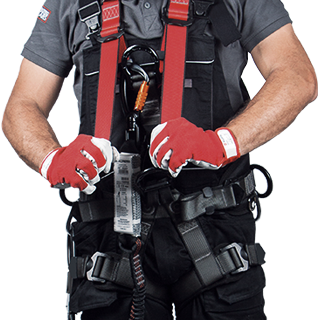
Multifunctional full body harness with single elastic lanyard
Five attachment points, suitable for rope access and rescue work. The integrated energy absorber limits the force transmitted to the body to a maximum of 6 kN.
EN 361, EN 355:2003
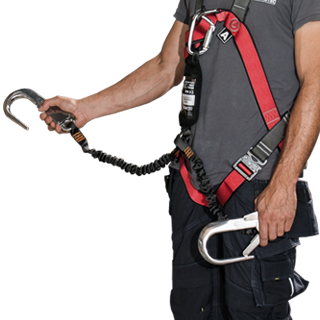
Two-point elastic harness with double elastic lanyard
Designed to move with the body, with automatic buckles. The double lanyard lets the user move between anchor points while staying connected at all times — no moment of being unclipped.
EN 354:2011, EN 362:2005
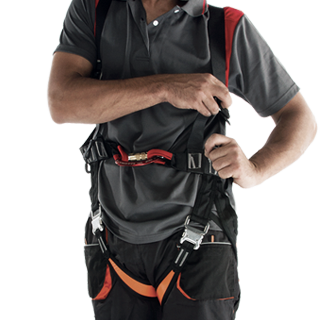
Prolight harness
A lightweight harness with padding for comfort over a long shift, arranged so that no pressure points build up during extended work.
EN 361
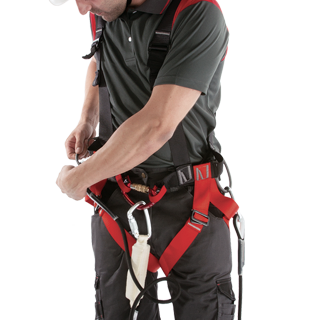
Tempo harness
A conventional webbing harness, recommended for temporary fall prevention work where the equipment is issued for a specific task rather than worn daily.
EN 361
Rope Access and Fall Arresters
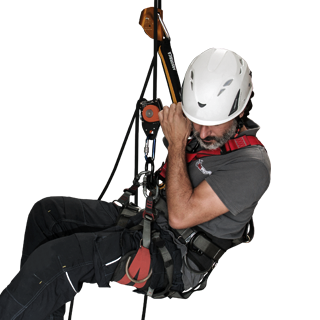
Work seat configuration
An ergonomic work seat combined with an automatic braking descender and a secondary fall arrest device — the standard arrangement for a rope access specialist working suspended for long periods.
EN 12841, EN 813
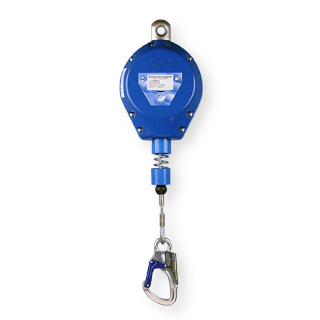
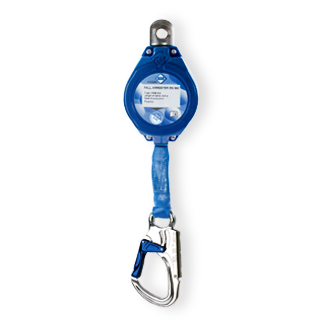
Compact retractable fall arresters
Available from 2 to 60 metres, with either a textile webbing sling or a galvanised steel cable. The block pays out as the user moves and locks on a sudden pull, keeping the free fall distance to a minimum.
EN 360:2003